The pictures are not photographs
Every illustration on this site, what it is, and the exact instruction that produced it. None of them is evidence of anything.
There is an old joke in newspapers about the prize photograph. You know the one before you see it: the doll lying in the ashes of a burnt-out house, one eye gone, shot at golden hour with the ruin thrown soft behind it. It wins things. It is also, if you have ever stood in a street where something actually happened, a little bit of a lie — a tidy frame put round a mess, a feeling delivered where a fact was wanted.
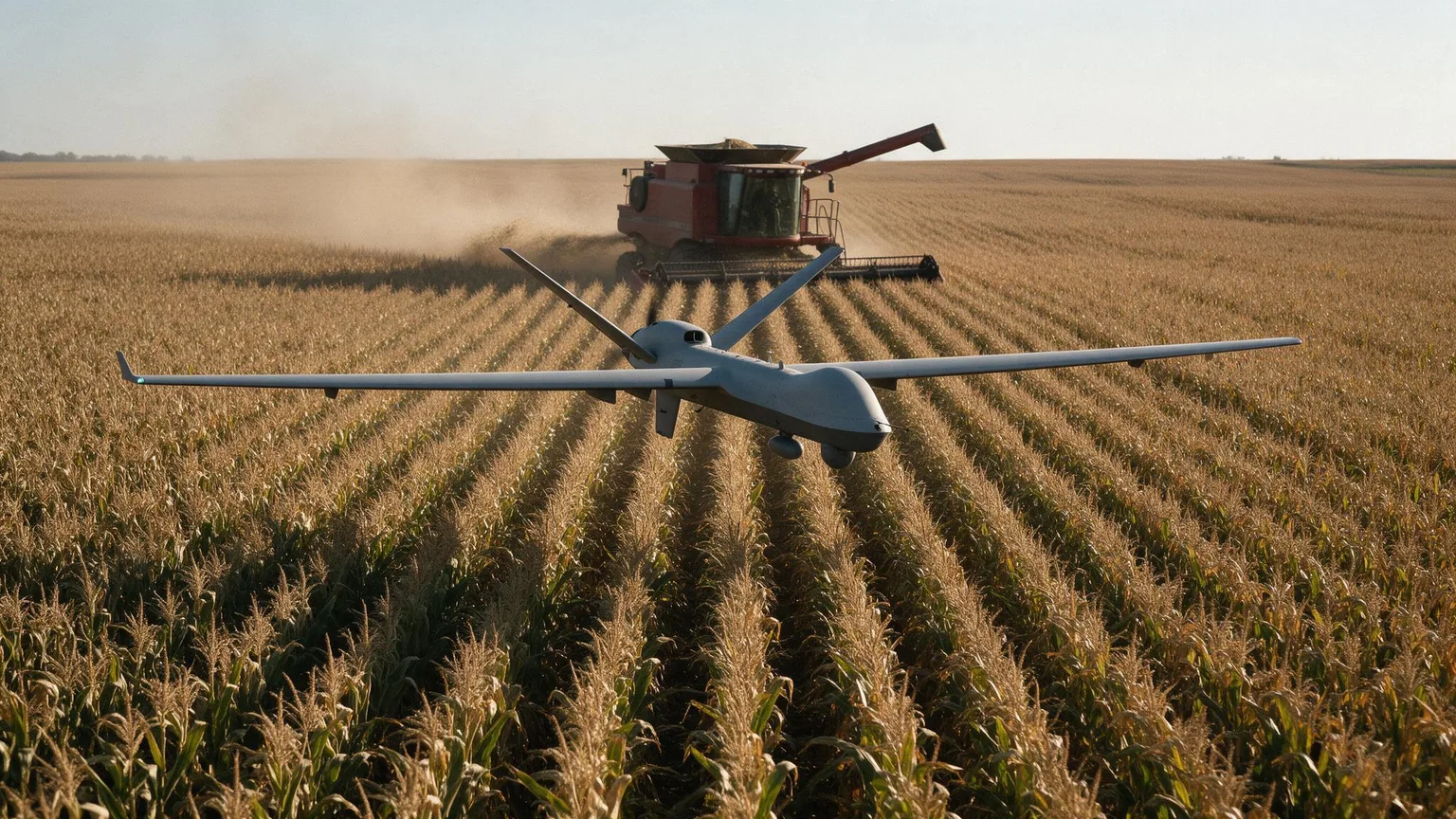
We do not have photographers. We are not going to pretend otherwise by running stock pictures of soldiers and calling it coverage. So the pictures on this site are drawn, by a machine, at our instruction, and they are jokes told with a straight face: the grammar of the prize photograph pointed at what this actually looks like from a county road. A drone at head height over the corn while the combine keeps cutting. The delivery robot waiting politely at the checkpoint. Forty cots on a gymnasium floor under a grinning cartoon bear.
They are meant to be almost funny. If you got as far as almost, that is the whole idea.
The rules they are made under
Nothing here depicts a real event, a real place or a real person. Not an incident, not a casualty, not a location you could point to on a map. There is no real person’s likeness in any of them.
No flag, no insignia, no unit markings, no brand name or logo. Nothing in any frame says whose hardware or whose soldiers these are. A picture that identifies a particular country’s soldiers standing in a particular street is a claim about the world, and we do not make claims in pictures. One of these had to be made twice: the first attempt put a flag patch on a sleeve, so we threw it away.
No legible text. Nothing in these frames is readable as a headline, a document or a number you could quote. The one exception is a gas-station sign with digits on it and no words, and the digits are nonsense.
They never illustrate a report. No article on this site carries a picture, and none ever will while we have no photographer. These appear on pages about us — this one, what we are for, how we work, who writes here, how to reach us, why we ask for money. Never over a story. Never next to a casualty figure. Never anywhere a reader could take one for a record of something that happened.
Every file says so, in the file. Each one carries the standard IPTC digital source type for material made by a generative model, plus the credit, in its own metadata. Strip the caption, download the picture, hand it to anybody’s verification tool: it still says what it is. A caption can be cropped off. That cannot.
The instruction is published. Every prompt is below, in full, and lives in the site’s source code alongside the page you are reading. We ask everyone else to show their working.
If you think one of these crosses a line, say so and we will take it down. That is not a formality. The single most dangerous thing a news site can do right now is put a picture in front of you that you believe.
The pictures
Harvest
A grey military drone flies low over a cornfield at sunset while a combine harvester keeps working in the distance.
The instruction that made it
A vast Midwestern cornfield in late September at golden hour, rows running to a flat horizon, dry tassels, dust hanging in warm low sunlight. A large grey military surveillance drone with a long thin wing and a sensor pod flies very low over the crop, close enough to lay a hard black shadow across the rows. In the middle distance a red combine harvester carries on cutting, unbothered, a plume of chaff behind it. Long telephoto lens, compressed distance, the drone sharp and the harvester soft. Nobody is looking up. Editorial documentary photograph, wire-service style, shot on a full-frame camera with a fast prime lens, natural available light, honest colour, fine grain, deadpan and completely serious in treatment with no visual humour, no caricature, no exaggeration, no surreal rendering. No text, no lettering, no signage copy, no watermark, no logo, no brand name, no national flag, no military insignia, no recognisable human face.
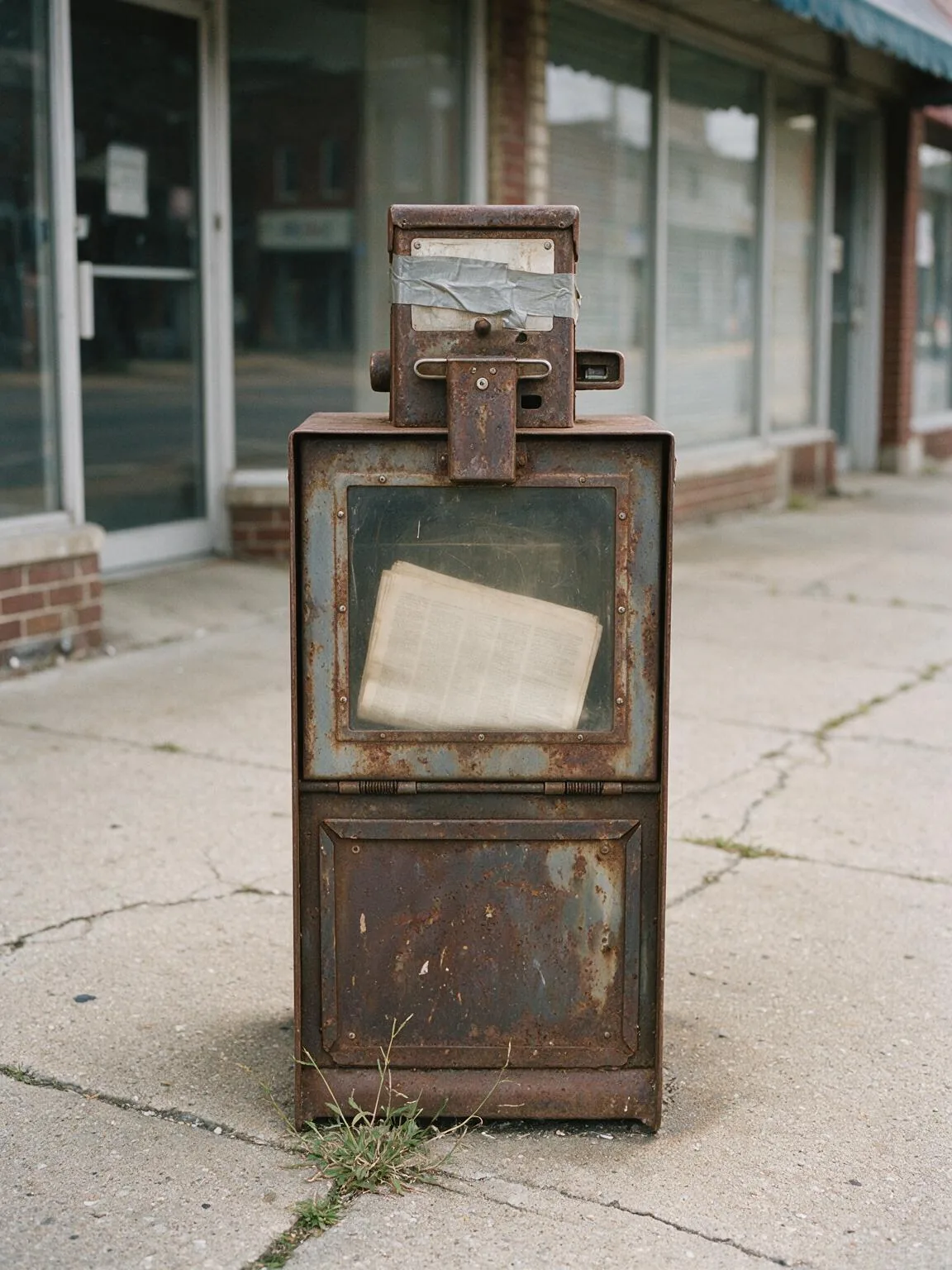
The last edition
A rusted newspaper vending box on an empty sidewalk, its window holding a single front page bleached blank by the sun.
The instruction that made it
A single rusted coin-operated newspaper vending box standing alone on a cracked small-town American sidewalk. The coin slot is covered with weathered duct tape. Behind the scratched plastic window sits one last folded front page, bleached by years of sun to a blank cream sheet with only the faintest ghost of grey columns left, no readable words at all. Weeds through the pavement joint at its feet, an empty street and shuttered storefronts reflected in the glass. Flat overcast light, muted colour, camera at the height of the box, shallow depth of field. Still, plain and unsentimental. Editorial documentary photograph, wire-service style, shot on a full-frame camera with a fast prime lens, natural available light, honest colour, fine grain, deadpan and completely serious in treatment with no visual humour, no caricature, no exaggeration, no surreal rendering. No text, no lettering, no signage copy, no watermark, no logo, no brand name, no national flag, no military insignia, no recognisable human face.
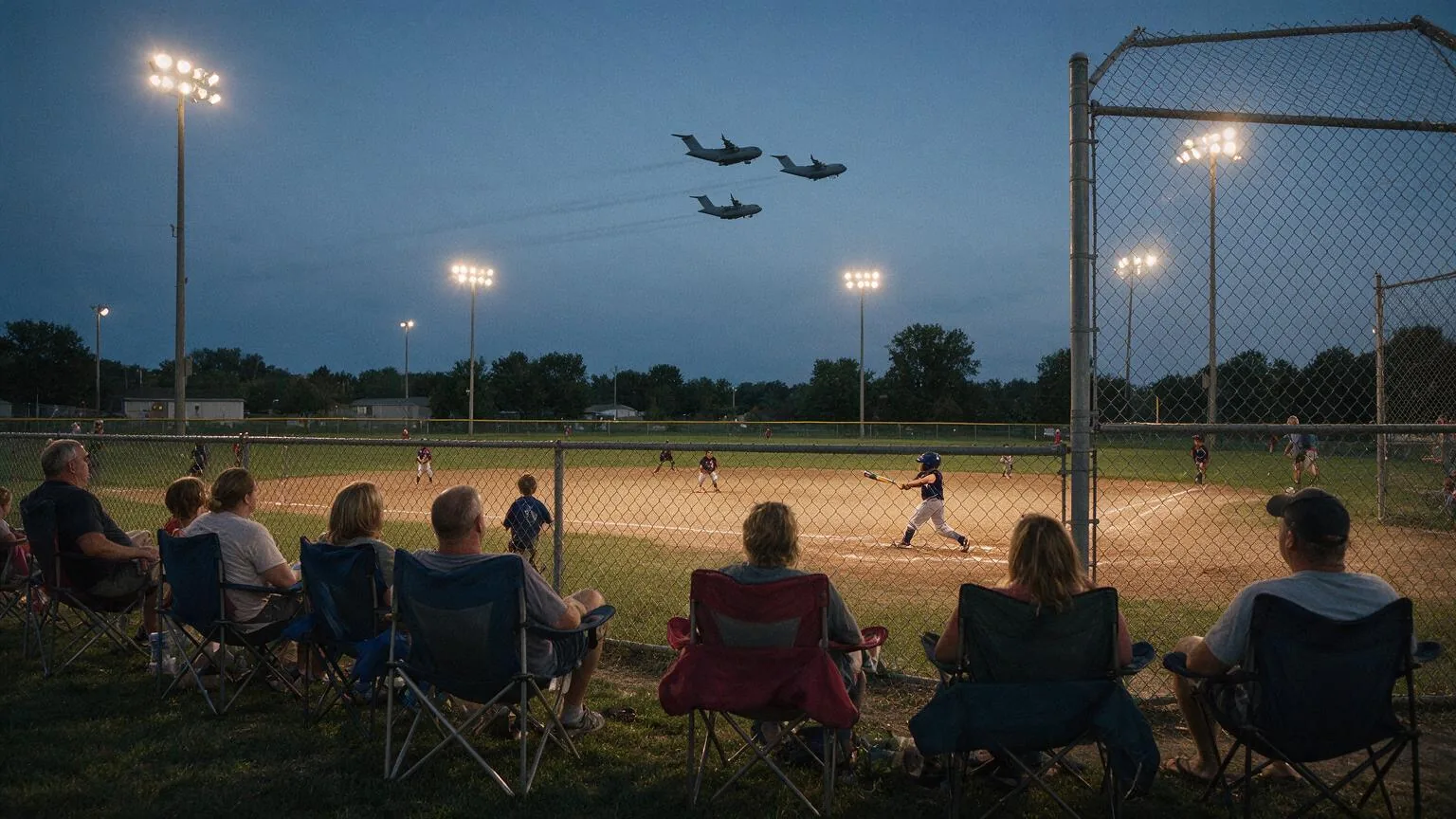
Bottom of the sixth
Parents watch a children's baseball game at dusk while a formation of military transport aircraft crosses the sky above the outfield.
The instruction that made it
A children's baseball game on a small municipal field at dusk, banks of floodlights just coming on, parents in folding camp chairs along the chain-link fence with their backs to the camera. The batter is mid-swing. High above the outfield, crossing a deep blue evening sky, a tight formation of four heavy grey military transport aircraft flying the same heading, small but unmistakable, leaving faint contrails. Not one person in the stands has turned around. Wide angle from behind the backstop, warm floodlight against cold sky. Editorial documentary photograph, wire-service style, shot on a full-frame camera with a fast prime lens, natural available light, honest colour, fine grain, deadpan and completely serious in treatment with no visual humour, no caricature, no exaggeration, no surreal rendering. No text, no lettering, no signage copy, no watermark, no logo, no brand name, no national flag, no military insignia, no recognisable human face.
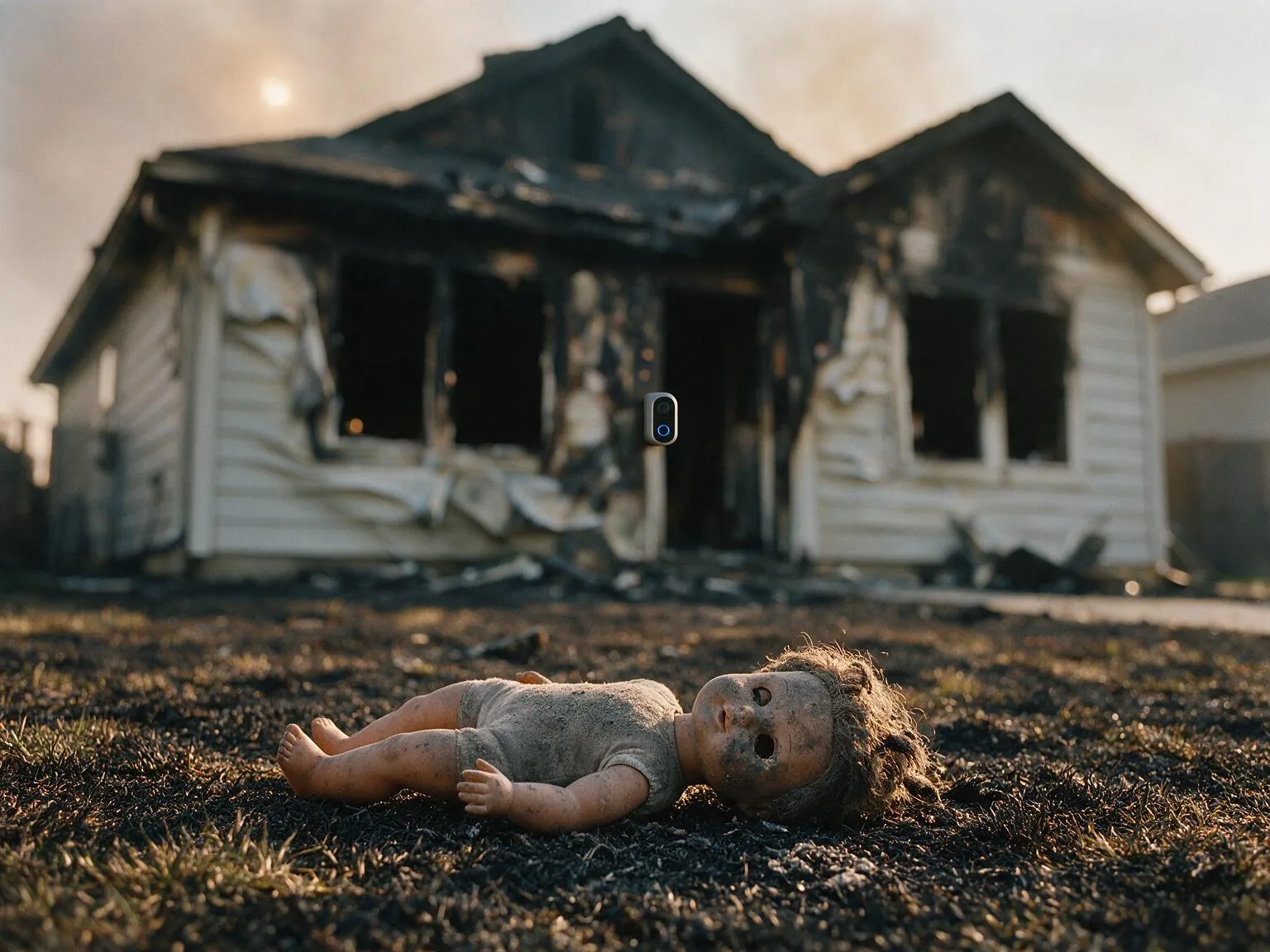
Still recording
A soot-covered doll lies on a burnt suburban lawn while a smart doorbell camera glows on the charred doorframe behind it.
The instruction that made it
Foreground, filling the lower third and razor sharp: a child's doll lying face-up on a scorched suburban lawn, covered in grey soot, hair singed, one eye missing. Behind it, thrown far out of focus, a burnt-out new-build American suburban house with melted vinyl siding and black window openings. Screwed to the charred doorframe, small but clearly visible, a modern smart video doorbell, undamaged, its ring of blue light still lit and still working. Late afternoon, low sun through smoke haze, wide aperture, extremely shallow depth of field. Editorial documentary photograph, wire-service style, shot on a full-frame camera with a fast prime lens, natural available light, honest colour, fine grain, deadpan and completely serious in treatment with no visual humour, no caricature, no exaggeration, no surreal rendering. No text, no lettering, no signage copy, no watermark, no logo, no brand name, no national flag, no military insignia, no recognisable human face.
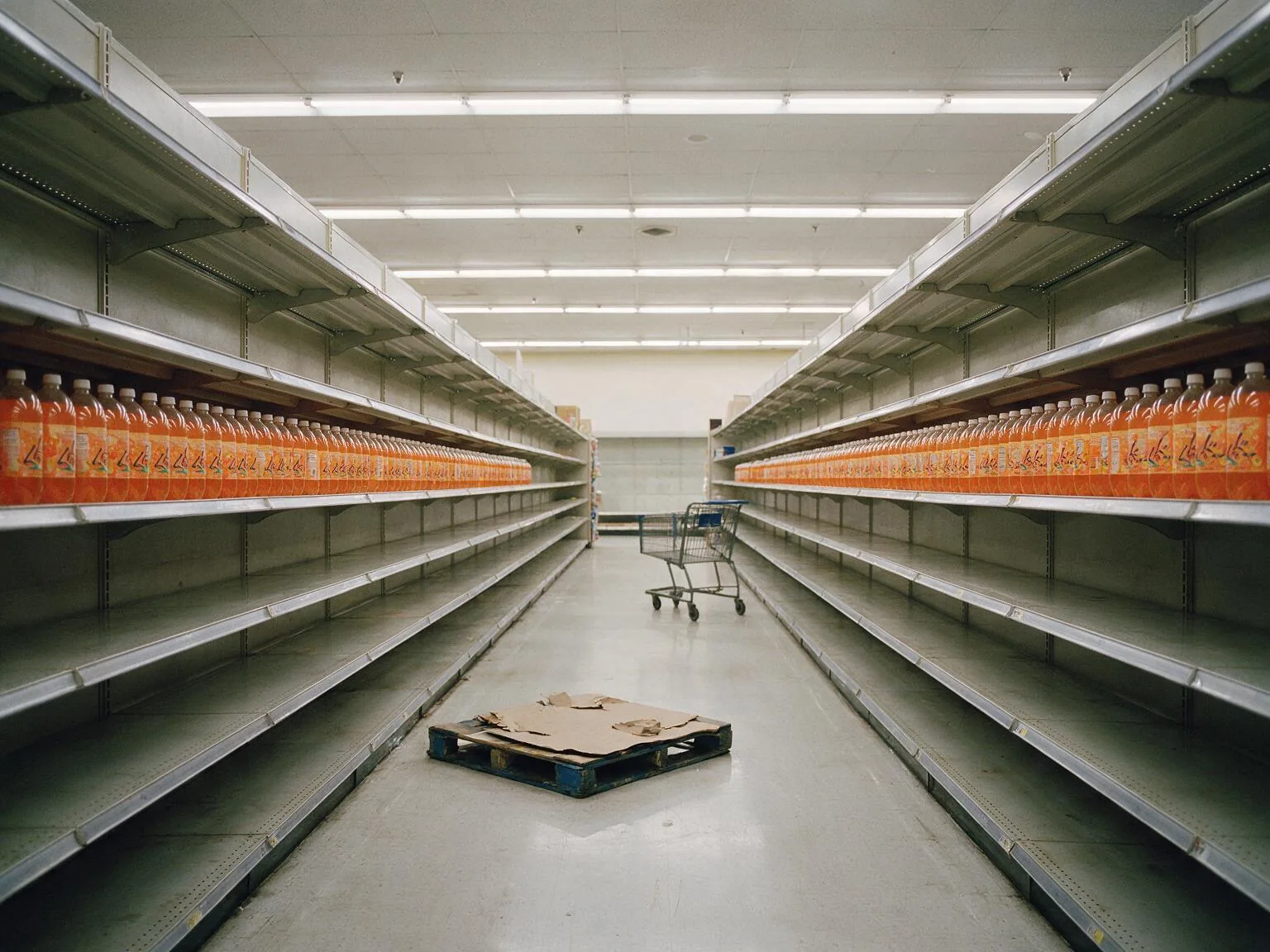
Aisle seven
A supermarket water aisle stripped to bare metal shelving except for one full shelf of a single garish seasonal flavour.
The instruction that made it
The bottled water aisle of a large American supermarket, stripped down to bare metal shelving and empty price rails, cardboard torn, one wheel-scuffed pallet left on the floor. Except for a single shelf at eye level, completely full and perfectly faced: row upon row of identical bottles of a garish orange seasonal-flavour sparkling water that nobody wanted. One abandoned shopping cart. Hard flat fluorescent overhead light, dead-on symmetrical composition down the centre of the aisle, wide angle, no people. Plain labels with no readable words. Editorial documentary photograph, wire-service style, shot on a full-frame camera with a fast prime lens, natural available light, honest colour, fine grain, deadpan and completely serious in treatment with no visual humour, no caricature, no exaggeration, no surreal rendering. No text, no lettering, no signage copy, no watermark, no logo, no brand name, no national flag, no military insignia, no recognisable human face.
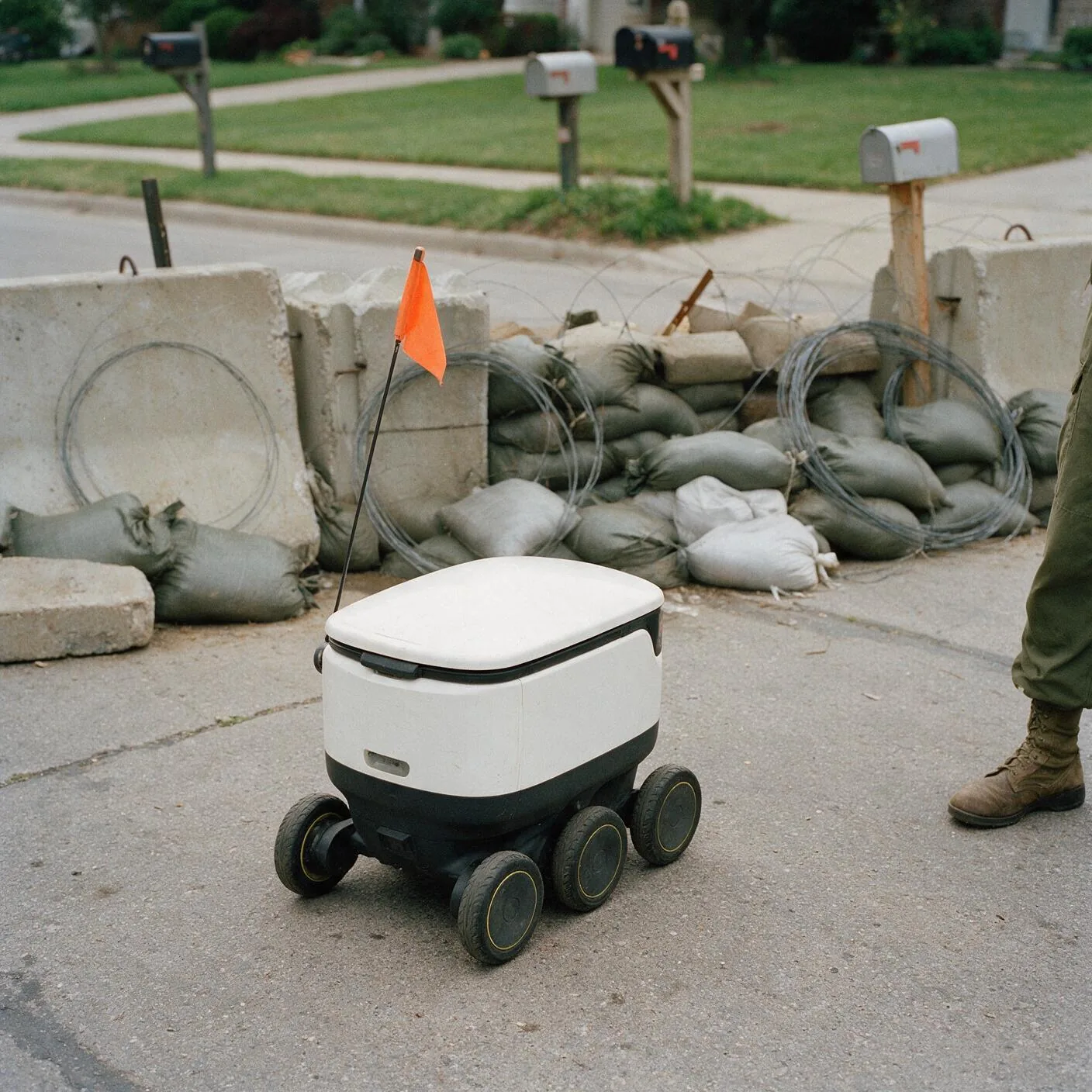
Right of way
A small sidewalk delivery robot waits at a sandbagged checkpoint on a suburban street.
The instruction that made it
A small six-wheeled white sidewalk delivery robot, about knee height, with its little orange safety flag on a whip antenna, stopped square in front of a hastily built checkpoint on an ordinary suburban residential street: concrete barriers, stacked sandbags, coils of wire. Its lid is closed. It is simply waiting to be let through, patient and entirely unbothered. At the extreme right edge of the frame, cropped off at the knee, the boots and lower legs only of one person in plain unmarked olive fatigue trousers: no torso, no arms, no shoulders, no sleeves, and nowhere in the picture any shoulder patch, flag, name tape, rank or badge of any kind. Overcast flat light, camera down at the robot's own eye level, mown lawns and mailboxes behind. Editorial documentary photograph, wire-service style, shot on a full-frame camera with a fast prime lens, natural available light, honest colour, fine grain, deadpan and completely serious in treatment with no visual humour, no caricature, no exaggeration, no surreal rendering. No text, no lettering, no signage copy, no watermark, no logo, no brand name, no national flag, no military insignia, no recognisable human face.
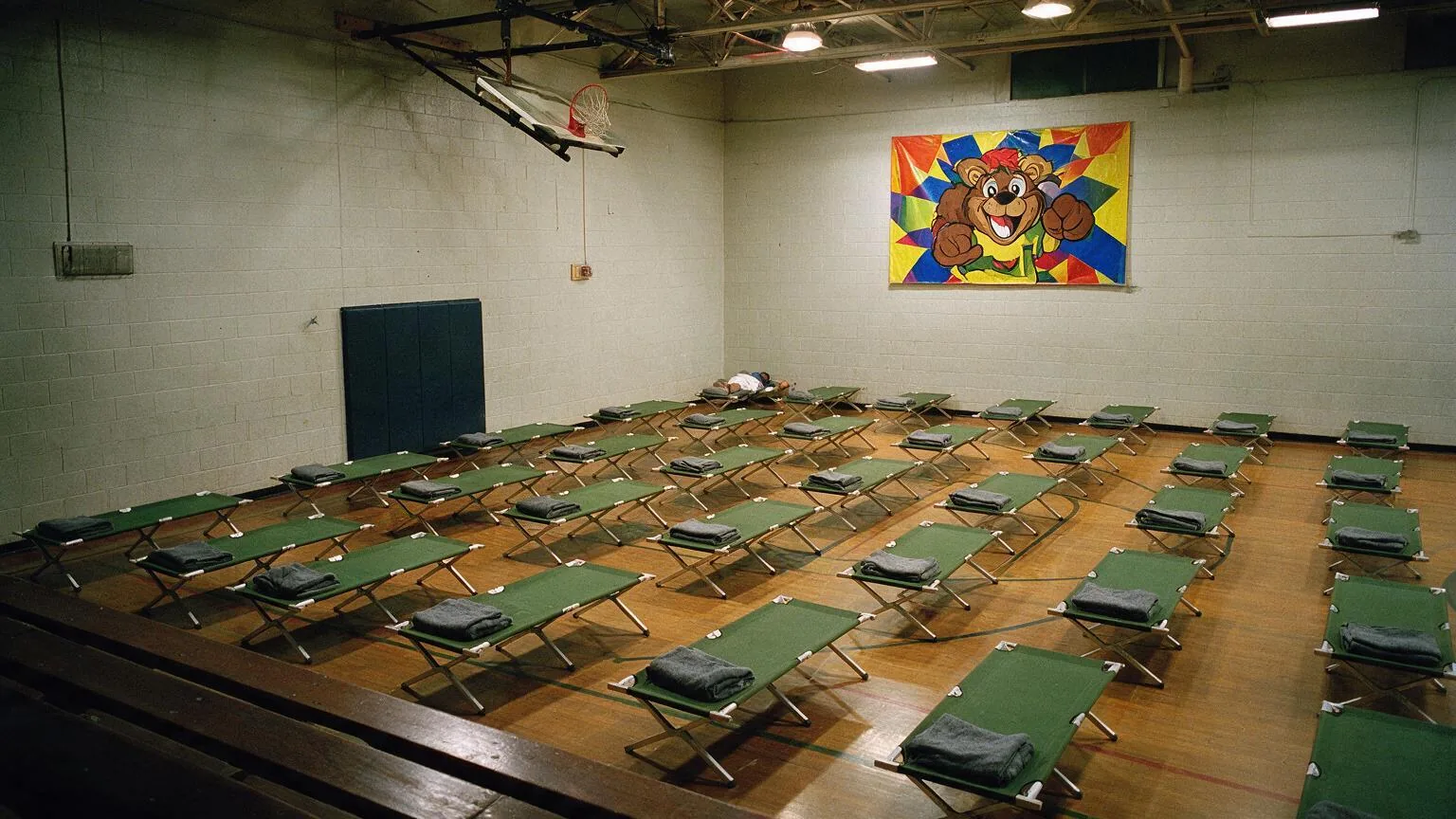
Go team
A school gymnasium filled with rows of emergency cots beneath a cheerful laminated sports banner.
The instruction that made it
A middle-school gymnasium converted into an emergency shelter: forty green military cots in precise rows on the varnished basketball court, grey folded blankets, a basketball hoop winched up against the ceiling, cinder-block walls. High on the wall above the cots hangs a big cheerful laminated school sports banner in bright primary colours with a grinning cartoon animal mascot, spotless and carefully hung. One person asleep on a cot in the far corner, small and unrecognisable. Harsh overhead sodium and fluorescent light, wide angle from the bleachers. No readable lettering. Editorial documentary photograph, wire-service style, shot on a full-frame camera with a fast prime lens, natural available light, honest colour, fine grain, deadpan and completely serious in treatment with no visual humour, no caricature, no exaggeration, no surreal rendering. No text, no lettering, no signage copy, no watermark, no logo, no brand name, no national flag, no military insignia, no recognisable human face.
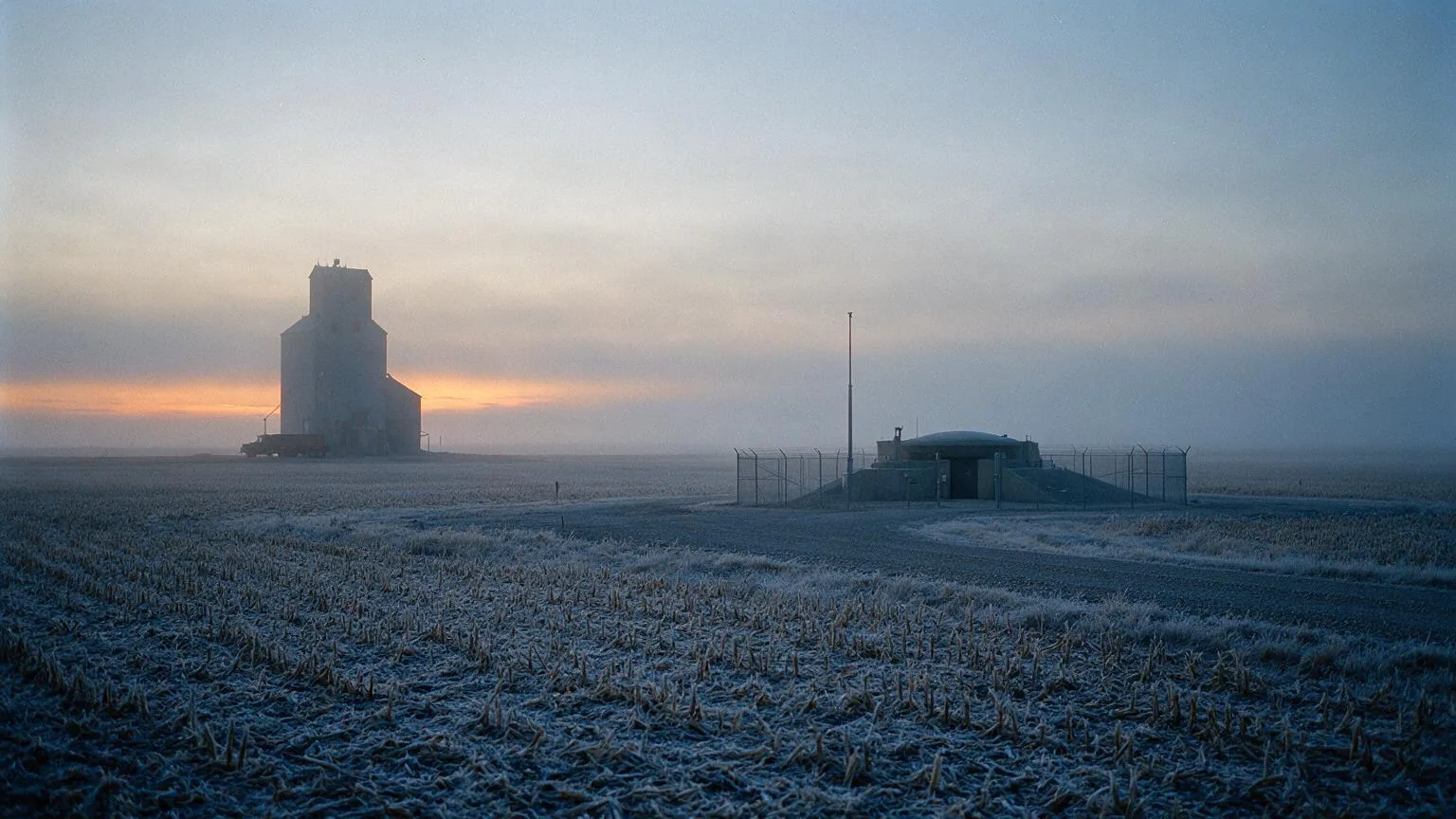
Two silos
A concrete grain elevator and a missile silo headworks stand in matching silhouette on a flat plains horizon.
The instruction that made it
A flat Great Plains horizon at first light, frost on stubble, heavy atmospheric haze. Two structures stand on the skyline at the same apparent size and nearly the same silhouette. On the left a tall concrete grain elevator with a farm truck parked beneath it. On the right, a mile further out, a hardened missile silo headworks: low grey concrete, chain-link perimeter fence, a tall antenna mast, a gravel access road running to it across the field. Identical dawn light on both. Very long telephoto lens, compressed layers, cold blue shadows and a thin band of orange sky. No people. Editorial documentary photograph, wire-service style, shot on a full-frame camera with a fast prime lens, natural available light, honest colour, fine grain, deadpan and completely serious in treatment with no visual humour, no caricature, no exaggeration, no surreal rendering. No text, no lettering, no signage copy, no watermark, no logo, no brand name, no national flag, no military insignia, no recognisable human face.
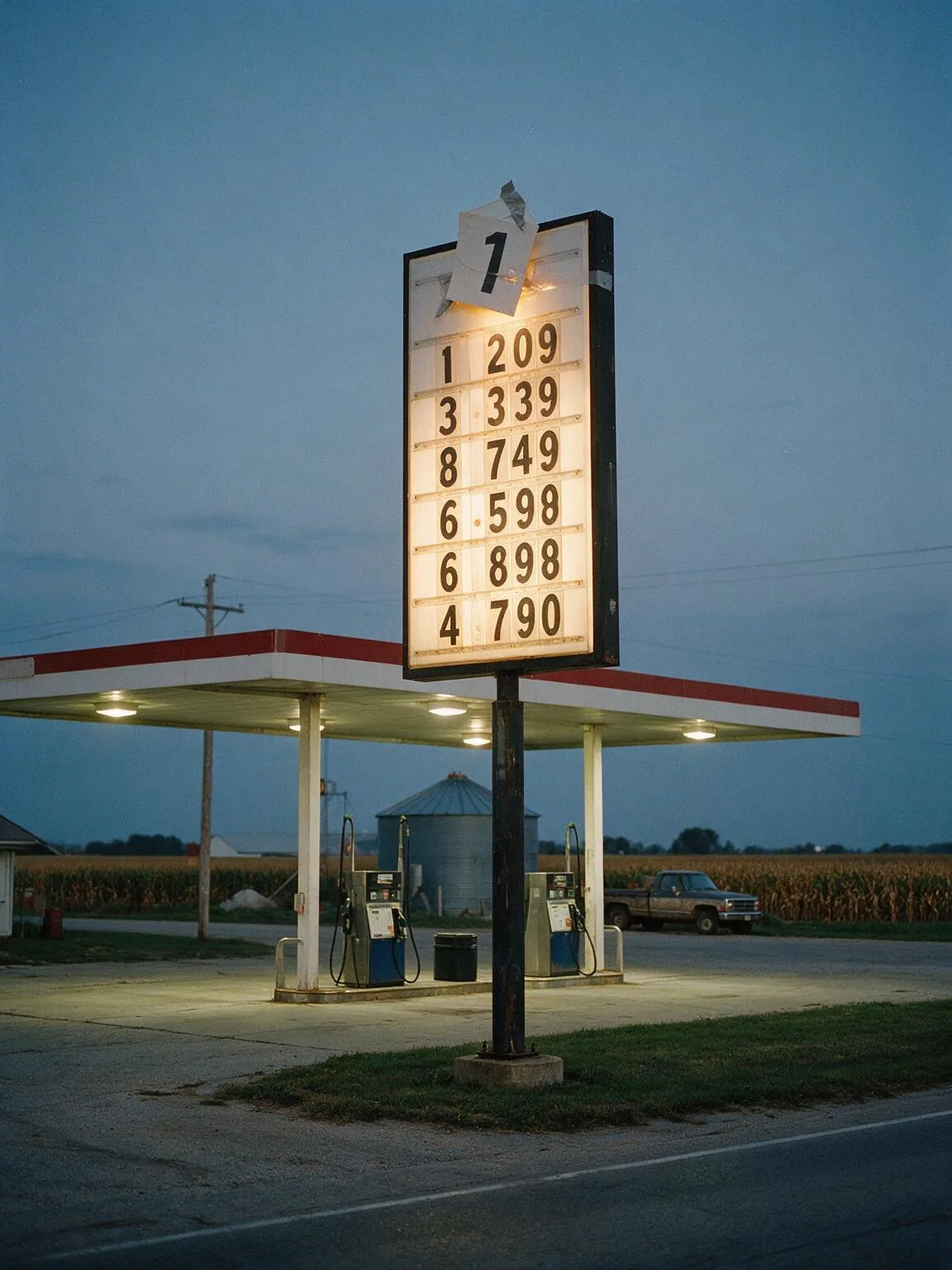
One more digit
A rural gas station price sign that has run out of digit slots, with an extra numeral taped above the panel.
The instruction that made it
A small rural crossroads gas station at blue hour, canopy lights on, pumps empty. The tall illuminated roadside price sign has run out of room: the plastic numeral slots are full, and one additional numeral cut from white board has been taped by hand above the panel, crooked, the tape catching the light. Numerals only, no words, no brand, no company name anywhere. One old pickup truck parked at the edge of the lot. Cold blue dusk against the warm glow of the sign, corn and a grain bin behind, vertical composition, no people. Editorial documentary photograph, wire-service style, shot on a full-frame camera with a fast prime lens, natural available light, honest colour, fine grain, deadpan and completely serious in treatment with no visual humour, no caricature, no exaggeration, no surreal rendering. No text, no lettering, no signage copy, no watermark, no logo, no brand name, no national flag, no military insignia, no recognisable human face.
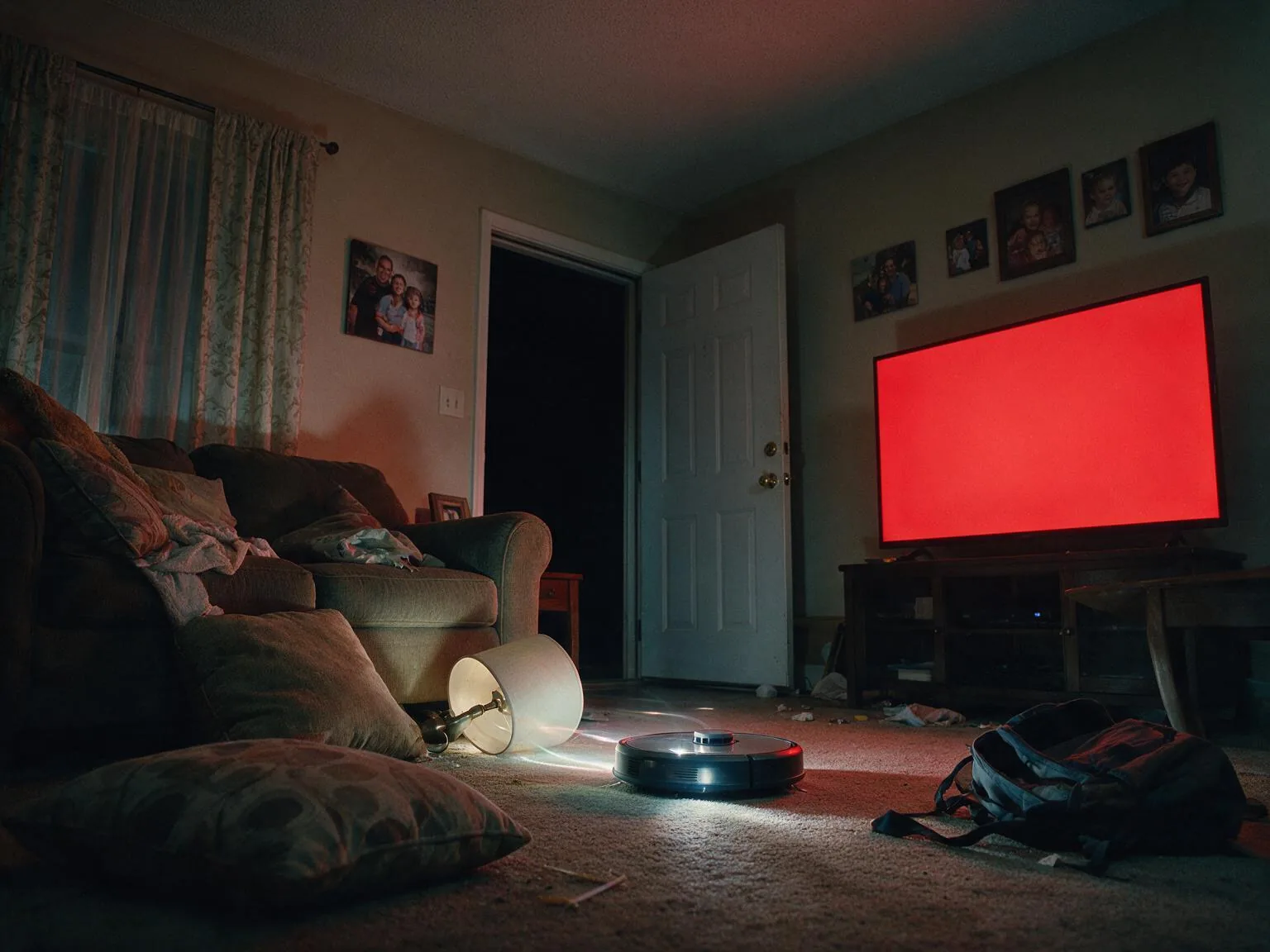
Clean sweep
A robot vacuum works its way around an abandoned living room lit red by an emergency broadcast on the television.
The instruction that made it
An ordinary American suburban living room, abandoned in a hurry: sofa cushions disturbed, a toppled lamp, a spilled backpack, the front door standing open onto darkness. A round robot vacuum is calmly making its patient circuit around the obstacles, dust bin light glowing, doing its job. The large wall-mounted television is still on, filled edge to edge with a flat emergency-broadcast red, no text or lettering of any kind on the screen, washing the whole room in red light. Family photographs on the wall face away or are too dark to make out. Low angle from floor level, long exposure, available light only. Editorial documentary photograph, wire-service style, shot on a full-frame camera with a fast prime lens, natural available light, honest colour, fine grain, deadpan and completely serious in treatment with no visual humour, no caricature, no exaggeration, no surreal rendering. No text, no lettering, no signage copy, no watermark, no logo, no brand name, no national flag, no military insignia, no recognisable human face.
This page was last reviewed on 19 September 2026.